Wednesday, June 20, 2007

Most recent posts have been about the Grease car project, now grease is similar to Greece, so the next posts are from a vacation in Greece, where the cars are very small, and the mopeds smoky. Smart cars are very common in Greece, and so are solar water heaters.


Thursday, December 07, 2006

The greasecar manual turns out to be incorrect with regards to installation for an F250 6.9L. On one trip I noticed the power decreasing dramatically to where we couldn't get up hills over 35 miles an hour. Initially it looked like it might be the injection pump going bad, luckily I had it checked by some folks familiar with this, and they determined that the veg was being pulled solely by the IP, which is not good. So it was replumbed through the lift pump. Also, the temp sender apparently is causing blockage, so they put that back into the Veg filter housing.

I also insulated the tank, so it can keep warmer, not sure how much difference it makes, but every little thing helps.

Thursday, October 12, 2006

Nuclear Power – One of Humankind’s Biggest Mistakes
By Jim Bell
www.jimbell.com, 619 758 9020

Nuclear Power was a mistake and remains a mistake. If the human family survives it, our descendants will wonder what we were thinking to justify leaving them nuclear power’s toxic legacy -- a legacy they will be dealing with for hundreds if not thousands of generations.

And why did we do it? To power our lights, TVs, radios, stereos, air conditioners, etc. and the tools we used to make them.

Our creation of nuclear power will be especially difficult for our descendants to understand because they will know that in the nuclear era, we already had all the technologies and know-how needed to power everything in ways that are perpetually recyclable, powered by free solar energy and which leave zero harmful residues in their wake.

On its own, nuclear power’s toxic radioactive legacy should be enough to give any thinking person sufficient reason to want to eliminate it as quickly as possible and do everything to protect our descendants from the radioactive wastes already created.

The human family has been at war with itself for the majority of its history. Human history is full of successful, advanced and sophisticated civilizations that utterly collapsed. To the informed, even our current civilization(s) don’t feel very solid. Plus there are earthquakes, tsunami’s volcanoes, severe weather, terrorism, and just plain human error. This given, who can guarantee that anything as dangerous and long-lived as nuclear waste can be kept safe for even 100 years much less the hundreds to hundreds of thousands of years it will take before some of these wastes are safe to be around.

And even if an insurance company did guarantee its safety, what is their guarantee worth? What could they do to protect us and future generations if San Onofre’s spent fuel storage pond lost its coolant water. If this happened an almost unquenchable radioactive fire would spontaneously erupt, spewing radioactive materials wherever the wind blew for weeks if not months -- rendering Southern California a dangerous place to live for thousands if not hundreds of thousands of years.

Notwithstanding the above, the nuclear industry is lobbying the public and the government to continue supporting them politically and economically so the industry can expand.

Its latest rational is that nuclear power will produce fewer greenhouse gases than what would be produced using fossil fuels to make electricity. This is true if one only looks at what happens inside a reactor. It’s not true when accounting for all the fossil fuel energy consumed during nuclear power’s fuel cycle, and what it takes to build, operate and dismantle plants when they wear out. Additionally, even if nuclear power was ended today, fossil fuel energy must be consumed for millennia in order to protect the public from the radioactive residues that nuclear power has already generated.

An increasing number of former industry and non-industry experts are saying that at best nuclear power releases slightly fewer greenhouse gases to the atmosphere than if the fossil fuels embodied in it had been burned to make electricity directly.

In his 2002 book, Asleep at the Geiger Counter, p. 107-118, Sidney Goodman, (giving the industry the benefit of the doubt on a number of fronts and assuming no serious accidents or terrorism), concludes that the net output of the typical nuclear power plant would be only 4% more than if the fossil fuels embodied in it had been uses directly to produce electricity. This means, best-case scenario, replacing direct fossil fuel generated electricity with nuclear generated electricity will only reduce the carbon dioxide released per unit of electricity produced by 4%. Goodman is a long practicing licensed Professional Engineer with a Masters Degree in Mechanical Engineering.

Other experts believe that nuclear power will produce about the same amount of energy as was, is, and will be consumed to create, operate and deal with its aftermath. This case was made in an article published in Pergamon Journals Ltd. Vol.13, No. 1, 1988, P. 139, titled “The Net Energy Yield of Nuclear Power.” In their article the authors concluded that even without including the energy that has or would be consumed to mitigate past or future serious radioactive releases, nuclear power is only “the re-embodiment of the energy that went into creating it.”

In its July/August 2006 edition, The Ecologist Magazine, a respected British publication, featured an16-page analysis of nuclear power. One of the conclusions was that nuclear power does not even produce enough electricity to make up for the fossil fuels consumed just to mine, mill and otherwise process uranium ore into nuclear fuel, much less all the other energy imputes required This is not surprising given that at typical U-235 ore concentrations of 01% to 02%, requires mining, crushing and processing a ton of ore to end up with 1/2 oz to 1 oz of nuclear reactor fuel.

To put this in perspective, the typical 1,000 MW nuclear power plants uses around 33 tons or over 1 million oz of nuclear fuel each year.

As a teenager I saw a TV program that showed a man holding a piece of metal in the palm of his hand. He was saying that if what he held was pure uranium it would contain as much energy as the train full of coal that was passing by him on the screen. I became an instant “true believer” in nuclear power. I thought if something that small can produce the same amount of energy as all that coal, there will be plenty of energy and therefore plenty of money to address any dangers that using it might pose.

Unfortunately, to get that level of energy from a small amount of pure or near pure uranium it would require that it be exploded as an atomic bomb. Of the uranium used in a reactor, only a fraction of the energy in pure uranium gets used. That’s why we have depleted uranium and other long-lived wastes.

The nuclear industry says that nuclear power is safe, a big net energy producer, and that it will be cheap and easy to keep its wastes out of the environment and out of the hands of terrorists.

But if these claims are true, why has an industry that supplies only 8% of our country’s total energy and 20% of its electricity consumed hundreds of billions of tax dollar subsidies since its inception? The 2005 Federal Energy Bill continues this trend. According to U.S. PIRG, Taxpayers for Common Sense, Public Citizen and the Congressional Research Service the recently passed 2005 Federal Energy Bill includes “a taxpayer liability of $14 to $16 billion” in support of nuclear power.

If nuclear power is so safe and wonderful, why does it require the Price Anderson Act? The Price Anderson Act puts taxpayers on the hook if the cost of a major radioactive release exceeds $10.5 billion. According to a Sandia National Laboratory analysis, this puts taxpayers on the hook for over $600 billion to cover the damage that a serious radioactive release would cause. Another Sandia Laboratory study focusing just on the Indian Point nuclear power plant in New York, concluded the damage caused by a serious release from that plant could cost up to a trillion dollars. Needless to say, any serious radioactive release from any U. S. plant would wipe out any net energy gain by nuclear power if -- there ever was one.

Realizing the potential cost of a serious radioactive release, manufacturers, insurers and utilities, were unwilling to build, insure or order plants. They only got seriously involved after the Congress assigned these cost to the taxpaying public.
On page 7, a report by the Institute for Energy and Environmental Research titled The Nuclear Power Deception, they included the follow 1996 quote from then NRC Commissioner James Asselstine, “given the present level of safety being achieved by the operating nuclear power plants in this country, we can expect a meltdown within the next 20 years, and it is possible that such as accident could result in off-site releases of radiation which are as large as, or larger than the released estimates to have occurred at Chernobyl.” Bare in mind, a meltdown is only one of several things that could happen with nuclear power to cause a serious radioactive release.

As I said in the beginning, nuclear power is a mistake. Especially considering we already have all the technologies and know-how needed to make us completely and abundantly renewable energy self-sufficient. Solar energy leaves no radioactive residues for our children or future generations. Additionally, although not completely environmentally benign yet, solar energy collection systems can be designed to last generations, be perpetually recyclable and leave zero toxic residues behind.

If San Diego County covered 24% of its roofs and parking lots with PV panels, it would produce more electricity than the county consumes. This assumes that 3 million resident use, on average, 10 kWh per capita per day after installing cost-effective electricity use efficiency improvements. For details read my free books at www.jimbell.com. They are also available in most local libraries.
For ourselves, our children and future generations, let’s move into the solar age.

Monday, October 02, 2006

"What Makes a Livable Community?"

Interdisciplinary Design Institute Hosts Third Annual Design Research ConferenceOctober 5 – 7. The Design Institute's third annual Design Research Conference will be held October 5 through 7 on the Riverpoint Campus. This year's theme is "What Makes a Livable Community?"

Among the activities organized for the event are a number of lectures, which are free and open to the public:

Thursday, October 5, 3:00 p.m. Human Nature and the Built Environment Joanne Savage, PhD American University, Department of Criminal Justice Thursday, October 5, 4:00 p.m.

Health and the Homeless Carol Allen, PhD Washington State University, Intercollegiate College of Nursing Friday, October 6, 9:00 a.m.

Sustainable Cave and Rammed-Earth Dwellings in China Liu Jiaping, PhD Xi'an University of Architecture and Technology, Green Architecture Research Center (Xi'an, China) Friday, October 6, 4:00 p.m.

Scandinavian Livable Communities Jerry Finrow, FAIA University of Washington, School of Architecture and Urban Planning Saturday, October 7, 9:00 a.m.

Straw Bale Housing in China Kelly Lerner, AIA One World Design All lectures will take place in the auditorium of the Phase I Classroom Building. For more information on the conference, visit the conference Web site. You may also contact Pam Medley at 509-358-7920 or pmedley@wsu.edu.

Thursday, September 28, 2006

Apples, Agriculture, and the New American Farmer. A documentary by Jamie Howell and Guy Evans, September 30, 7pm. Met Theater, 901 W. Sprague
Apple tasting and discussion with the filmmakers to follow.
www.brokenlimbs.org

Monday, September 18, 2006

This Green Electronics Guide ranks leading mobile and PC manufacturers on their global policies and practice on eliminating harmful chemicals and on taking responsibility for their products once they are discarded by consumers. Companies are ranked solely on information that is publicly available.

http://www.greenpeace.org/international/campaigns/toxics/electronics/how-the-companies-line-up

Saturday, September 16, 2006

ECO DEPOT IS MOVING TO A NEW LOCATION!1326 E. SPRAGUE AVETHIS IS YOUR INVITATION TO THEIR OPEN HOUSESEPTEMEBER 15, 2006, 4 – 7 PM.Come see their new place and their expansion plans. Their inventory is growing!Meet Kelly Lerner, architect and author of a new book "Natural Remodeling for the Not So Green House".Bring your copy or buy one and have her sign it.

Tuesday, August 01, 2006

Waste Vegetable Oil, what it looks like

This is what one particular restaurant's creamy frying shortening looks like after being used one week in the fryers, then settled in the garage for another two weeks. The bottom is the crud and the hydrogenated stuff, and the top is colored and not hydrogenated or partially hydrogenated. I will pour this through the sock filters when enough oil has accumulated for a new batch.

Thursday, July 13, 2006

State offers incentive for home solar-power units
Pumping electricity into grid pays 15 cents a kilowatt-hour

http://seattlepi.nwsource.com/local/277105_solar11.html

Tuesday, July 11, 2006

Downtown Recycling Club!

The Lands Council has a new project: The Downtown Spokane Recycling Club. This project, which consisted of surveying local restaurants, pubs, and bars to assess rates of recycling and business reasons for lack of recycling, was conceived to increase the rate of recycling among local businesses. If you go to their website, you'll find a link to the project, and then a link to cards that they have created. These cards ask businesses to start recycling. You can bring these cards with you to restaurants, and ask them if they recycle, and if so what they recycle. If they don't, or have limited recycling, leave a card with your bill to encourage them to start recycling. If they do, make sure you thank them. Consumer pressure for recycling is the best way to make businesses listen. With your help, we can begin to increase the rate of recycling among businesses here in Spokane. Thank you! Here is a link to the recycling page:http://www.landscouncil.org/Downtown%20Spokane%20Recycling%20Club/Downtown_Spokane_Recycling_club.html

Saturday, June 17, 2006

Reasons for Converting to Straight Vegetable Oil

This will probably change some, some of these reasons also apply to Biodiesel users, however SVO has the added advantage of not dealing with Methanol and caustic soda or lye and further heating, using more energy..)

-- Decreasing our dependence of foreign oil. (The latest stat was that we rely 65 % on foreign oil, or 13.2 imported barrels a day)
http://oversight.house.gov/Documents/20050720134711-47263.pdf

-- Diversification and de-centralization of energy sources (The potato blight or great Irish famine taught, or should have taught all of us that planting one crop, or putting your eggs in one basket is not a sensible, sustainable, survival strategy, same with energy sources, diversification is the key to long term survival, preferable using sources that decrease our harm/resource footprint)

-- Recycling waste restaurant oil makes sense (this stuff has a lot of energy in it, I get pretty much the same mileage and power from this as from regular dino diesel) Some folks would add that running on waste oil saves them money, this would primarily apply to people with large daily commutes. I have invested about 1500 dollars in the setup and use the bike several days in the week as well as telecommute one day out of five. Also not counting buying an old diesel truck, so I don't see it making money any time soon)

-- Recycling waste heat from the engine to make the oil thinner, or lower it's viscosity (so that it gets close to that of diesel and prevents coking or gelling). I read somewhere that the engine produces enough waste heat when running to heat a house, this is very inefficient, so re-using this waste heat makes sense.

-- 50 + percent reduction in particulates

-- Carbon Neutral, doesn't contribute to global warming.

-- No sulfur (the stuff that causes acid rain and cancer and is bad for your health)

-- sulfur is added to diesel for lubrication, well, vegetable oil lubricates even better and doesn't need it added. (when I switch to vegetable oil, I hear a reduction in engine knocking, it just seems to go a bit smoother, some folks say it is less noisy, perhaps someone can do an audio test)

-- Help the local farmers grow canola or rape seed as a rotation crop and an extra source of income (again not putting all the eggs in one basket seems to be key in survival), it doesn't have to replace food crops, and rotation crops help retain the precious top soil, a clear win-win for the farmer and the land, assuming the farmer is using sustainable practices. If I were a farmer I'd add some windmills and or solar panels, fast growing living fences that are harvestable, as well to generate additional income on those windy hills. Basically diversification.

-- Re-using existing diesel vehicles to create a hybrid is cheaper than buying a new hybrid that is still dependent on fossil fuel. In other words, if you can't afford a 20 thousand dollar vehicle, but still want to have a hybrid, this is the cheapest route. If you have a gasser, you could still have a hybrid, take the car half way to work, and bike or walk or take the bus, that cuts your fuel costs in half, and feels good physically. You can then throw out the gym membership as well, as now you get your exercise when going and coming to work.

-- Re-connecting with other members of the community, with the farmers that grow our food and fuel, re-learning to share equipment and resources, rooted in an understanding that we are in this together and that we're not so separate as we have been conditioned to think, this has nothing to do with some romantic notion, it is key to long term survival and increasing wealth to many, rather than concentrating it for a few at the cost of others. Everyone has something unique to contribute to this world but few realize their potential and their right to inhabit this world and be respected as much as the next person. Much of our conditioning is still based on the fictious concepts of class/color/gender etc.. separations, certain people are special and the rest are "lesser" who need to be put into complacency. It is easier to control others and disempower humans when you have convinced them they are of lower value to the world.

Below are some thoughts and reflections that seem to want articulation and that may or may not be of interest, for what it's worth..

If one slows down, and looks around, one can see beauty all around. An obvious example is when you stand on a mountain in the desert and you look at this display and sharing of unconditional beauty. But as Joe Campbell used to say, seeing it in the mountains is easy, seeing it in the slums of Detroit is a bigger challenge.


The birds sing their songs regardless of who is listening, the mountains show their beauty and play with the light and clouds, why can't we humans too, share ourselves unconditionally? Is any flower or mountain exactly the same? No, they all have something unique and can be appreciated for that, so we too can share our uniqueness unconditionally. Value judging ourselves, and consequently others, has created a big boundary that I believe keeps us from walking on the "pollen path" as the Navajo call it. What is the pollen path? You're on it...................However, your sight might be obscured, clouded, covered up.

I believe running an old polluting vehicle and transforming it into something less harmful, without building new vehicles is a nice way to make the transition to a sustainable lifestyle, and re-use what we have. Transformation of oneself into something that is less harmful seems to influence those things around us that were also the products of the state of our minds at the time. If you change your relationship to yourself and the world, the world inevitably starts reflecting this different relationship in small but noticeable ways (some would argue that it takes transcendent endurance to see the changes, but I don't think it is that bad).

It is therefore logical to see what is around us and what we have created as a reflection of our own inner state of mind. Thoughts are seeds that when cultivated and watered in our minds crystallize outward. It doesn't take much reflection to realize the implication of responsibility we have for our own thoughts and their resulting consequences that ripple outward. I don't believe in a distinct right and left, I believe we all want happiness, the trick is finding out an imperfect but workable win-win route for all parties involved, this is a process fraught with trial and error, hard for the perfectionists in ourselves, but doable with some patience and creativity and perhaps most important of all, humility.

Back in Spokane, WA

Arrived late last night, drove from Bend, Or most of the day at an average of 55/60 M/Hr. Most folks drive faster, but this drags down the mileage, hurrying is something that I prefer to avoid. Life goes by faster when you hurry interestingly..Quantity doesn't stand a chance against quality. To experience quality one has to slow down.

We drove around 2800 miles on vegetable oil in 21 days. Most oil was waste oil from restaurants, filtered by the folks previously described. The only part where we purchased new oil was in Reno, where we bought 7 cubies of oil at Costco. It felt great to do that too, as this oil burns way cleaner than Diesel and smells very good.

Please check out this technical data from greasecar that compares emissions and particulates:
http://www.greasecar.com/tech.cfm
Bend, Oregon

We met Kevin in Bend, after driving all day on the purchased 7 cubies from Reno, even with the 1 hour plus diversion to Pyramid Lake, we made it just in time before the tank ran empty. He had plenty of oil as well and we compensated him for his efforts and asked for the closest place to wild camp, or dry camp in the area, so we could visit my wife's favourite Mexican restaurant.

He has done a bunch of conversions and has sold some of his cars. He estimated that there are perhaps 15 SVO grease cars in the Bend area, which is a lot, as Bend is a fairly small town, 70.000 people, and there are a bunch of biodiesel folks. They have a Co-op and are making biodiesel for 2.99 a gallon if I recall correctly..

Wednesday, June 14, 2006

We still torture ourselves and others on this planet, but what about this sunrise (some of these enlarge when you click on them)?

How do YOU respond to your planet that is always there for you regardless of how you treat it?

My wife has been a great help to this temporary incapacitated person now writing. Before heading north, we stopped by the Reno Costco, 11.99 for 4.67 gallons, comes out to about 2.55 a gallon! Compare this to 18 dollars a cubie in the Tri-Cities a bit up north, and that doesn't include tax. Nice soybean oil, not hydrogenated. We poured about 5 cubies in the tank, hopefully this will get us to Bend, Or, where another person has offered to help us with oil. We're camping by Pyramid Lake tonite on the Paiute Indian Reservation. The weather had turned dark, but the resulting views made it all the more spectacular..Even though it is only a 40 minute drive north of Reno, the place was pretty much deserted a bit past the beginning of the lake, we had no company, and the night was completely dark....

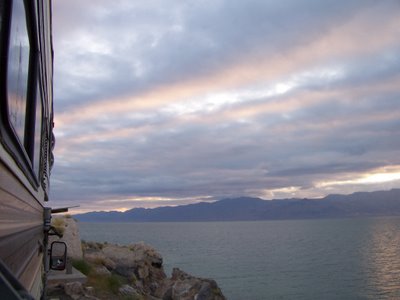

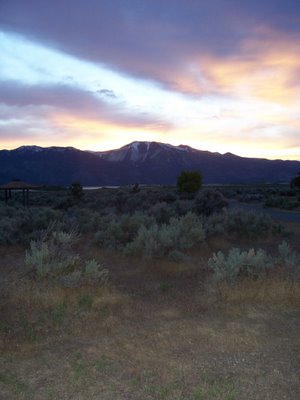
One week later, back in Carson City for a hospital visit, wrecked my back so a week of no-doing is required. The injury was re-opened from hiking/bicycling down this very rocky mountain above (camp site is at the lake below), without suspension. A previous back injury has come back in full force but didn't rear it's head until a couple days after the ride.

Wednesday, June 07, 2006

Reno, NV. Filled up the tank once we got there with spare cubies to get a sense of what it took to get from Oakland, Ca to Reno, over the donner pass, 7000 feet. about 240 miles took almost 4 cubies (4.67 gallons per cubie). This with the doghouse/camper on our backs. So that works out to about 13.5 m/g

Near Fallon, NV

Below are some pics from miscalleneous trips near Fallon, we did some great wild camping there..


Kristina is standing in front of a 600 foot sand dune, it is one of only 3 in the world that makes a musical sound when the sand crystals move. But it is on BLM land, and the sand buggies, and motor cross folks seem to really enjoy going up and down the dune, not sure if there is a time to hear the singing dune. I hope to hear the voice of the dune some day..
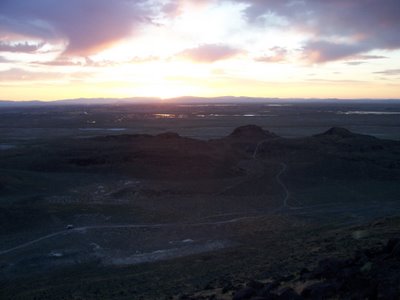
The sunset is reflected by wetlands in the west below the desert sky.

Berkely - Oakland


A visit with Duncan who generously donated a bunch of oil in exchange for beer, to get us to Reno and some extra.

After that a nice lunch in (what I believe is the future of food and of survival), a Vegan, organic, live foods restaurant in Berekeley. Again, these folks were great, even the towels were washable, sustainable. "Cafe Gratitude" (I think that is their name) http://www.withthecurrent.com/

I realize to some this is going to far, but is it really? I have a friend, Jim Bell, who simply believes that we are in the process of becoming more conscious, less of a jerk. Conscious of what? Of who we are and our interconnectedness..This is not an easy concept to intellectually although science is really helping explain it, for most people it takes some form of solitute or contemplation to start understanding this at a deeper level.
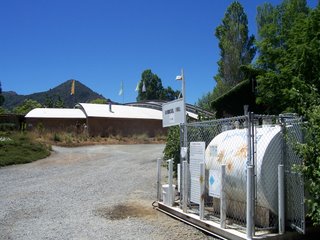
Real Goods, Hopland, Ca ---

This is one of my favorite places to get inspired about sustainable living, their whole store is practicing what they preach, passive solar heating, they have a large array of solar panels, straw bale construction, composting toilets, edible shade landscaping, biofuels, and lots of books and interesting stuff to buy. During the trip I read one of their books, "The Renewable Energy Handbook", by William H. Kemp. Really enjoying the book, but I will write him about his bias against SVO, I think he has not spend enough time researching this. He touts Biodiesel, but why not tout both..hopefully he will reconsider his bias on this subject and change the next edition.


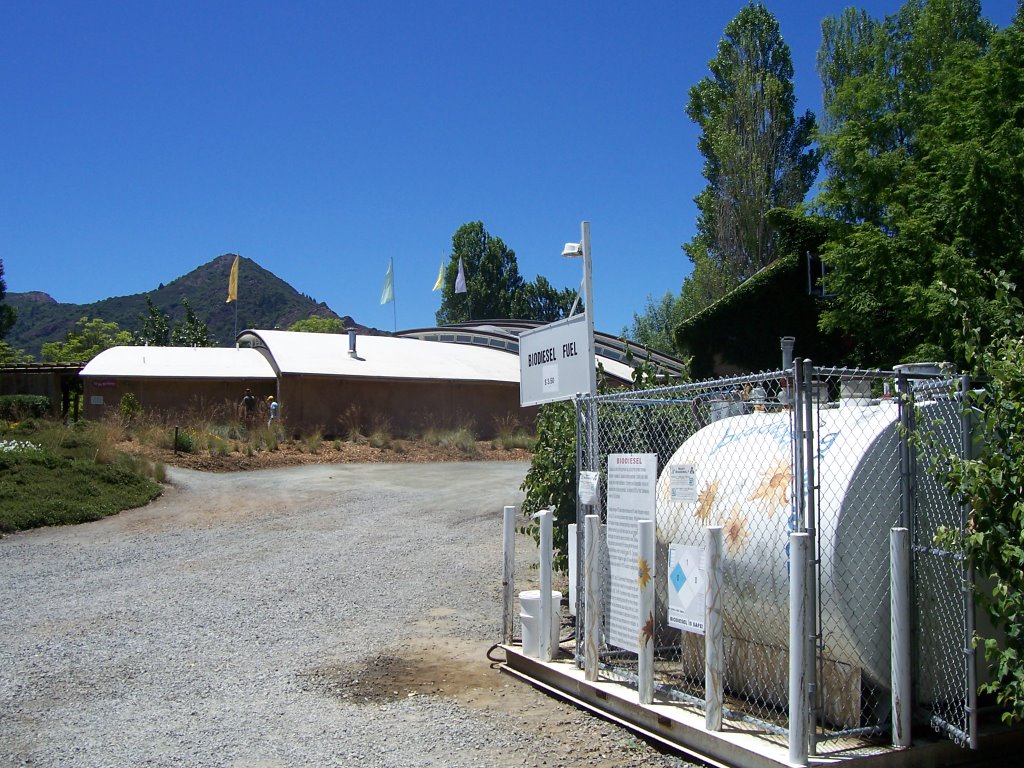
Above is the pump at Real Goods, their pump was broken at the time, but they were selling B100 for about 3.50 a gallon.
They sell two biodiesel processors, the push button types, just add ingredients and click the start button, and 24 hours later 50 gallons of B100.

Their prices were 5-8 K.


Lake Sonoma -- some beautiful hiking in oaks and grasslands, there are some areas of the lake that have boats with some impressive sound systems, but a bit further up, all you hear is interesting crickets in the oak trees, at least that is what it seemed like. Both sights and sounds were impressive.

Ukiah Biodiesel, Laytonville


Prairy Creek Beach

Before we got to the beach campground, I noticed a slight lack of power. Since the greasecar filter hasn't changed since the first install, I decided it was time to change this filter with a similar filter from Napa. This is a bit messy, as the filter is filled with vegetable oil, and the new filter has to be filled up with vegetable oil, to minimize air pockets. Since this was the first time and we're still a bit far from Arcata, I hoped we wouldn't get stuck. Decided to get it going before the somewhat treacherous trip through the muddy steep dirt road over some mountains to get to the beach. A bunch of elk were not too interested in the sound of a diesel, so they moved away. The german shepard that is one of our 4 dog passengers in our big driving doghouse also noticed the elk and started barking. When I started on diesel and switched to veg, the engine stalled...oh, oh. Back on diesel, after some starting this worked, and I decided to go fast on the highway, to make it easier to switch to veg. This worked, a bit of sputtering to work out the air, but it got better. Pictures to follow, as this library has a somewhat antiquated computer setup. Sometimes libraries can't be used as they require log-ons to use the internet. But the smaller towns seem to be less sophisticated so those work better.

The Dog House

Luckily we're not into carpeting, as the dogs enjoy the water and Skeeter below has a thing with digging in the mud..

As Bailey the Shepard is rather large for this camper, laying on the ground takes up more space than just sitting in the dinette, so we preferred her sitting in there..